Featured Apprenticeship: Powers of Arkansas
- Job Seeker
- Employer
- Trainer & Educator
- Apprenticeships
- Career Descriptions
- Employment
- Energy Efficiency
- Training and Certification
Learn about the Apprenticeship Program at Powers of Arkansas for Instrumentation and Controls Technicians.
Employer
Powers of Arkansas
Program Sponsor
Apprenticely in partnership with Arkansas Advanced Energy Foundation
Apprenticeable Occupation
Instrumentation and Controls Technician
Employee Title
Controls Technician
Date Established
November 2023
Registered / Operating In
Arkansas
Format / Length of Program
Competency-based, approx. 2.5 years
Related Technical Instruction
360 hours delivered in-house by subject matter experts on staff, supplemented by training offered by equipment manufacturers
Program at a Glance
Powers is the largest privately held building HVAC, controls, and service company in the state of Arkansas, offering energy efficiency services to schools, hospitals, and commercial and industrial facilities throughout the state.
In 2023, Powers launched a Registered Apprenticeship program aligned with the Instrumentation and Controls Technician occupation.
The program is sponsored by Apprenticely and was developed in partnership with the Arkansas Advanced Energy Foundation, a partner in the Apprenticeships in Clean Energy (ACE) Network. Powers developed and offers the competency-based curriculum entirely in house. This approach allowed them to tailor learning outcomes to the skills needed on the job, and invest in career growth across their team.
The competency-based program takes approximately 2.5 years to complete. The first cohort of 12 apprentices is still currently in the program.
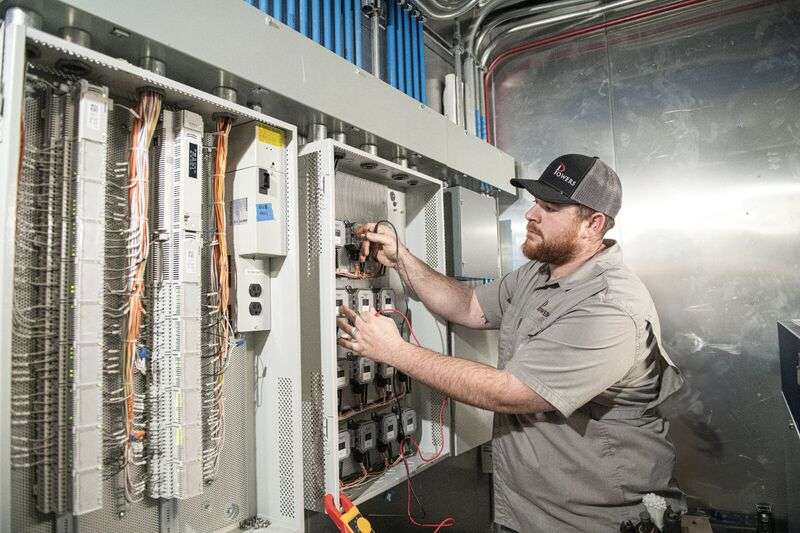
Photos courtesy Powers of Arkansas
Developing & Registering the Program
In recent years, Powers has experienced hiring challenges, particularly in identifying enough qualified candidates to join their growing team of dedicated and talented HVAC professionals.
Community colleges in the region offer residential HVAC training, but there was no local pipeline for the commercial sector. Powers recognized that while building training partnerships with colleges is valuable for long-term workforce development, it can take a long time. Registered Apprenticeships presented an immediate workforce development solution to upskill current employees on the job, and develop a formalized, customizable talent pipeline for future growth.
Beth Wiliams, Human Resource Manager at Powers, reflects that “leadership buy-in is important to invest in workforce development, and through the apprenticeship program, they’re able to build their workforce to be ideal controls techs, to provide the level of service customers expect.”
The program was developed internally with input from subject matter experts and early career staff. Apprentices gain a strong foundation in the fundamentals of building controls. They are trained as Controls Technicians, with an advancement pathway to Controls Specialist or a field supervisory position. Instrumentation and Controls Technicians install, calibrate, maintain, adjust, and repair sensors, meters, gauges, dials, and control boards for commercial building systems, including complex HVAC equipment.
“The Powers of Arkansas Apprenticeship program is a great tool to help people who are just starting out in the HVAC controls field. There is a good mix of online training and also in-person instruction. The thing I like the most about the program is that the apprentice can pick their own path. There are a few different directions someone can go in the HVAC controls field. Being able to pick the course that’s best for you and your career has helped me become a better employee and coworker. It’s never too late to better yourself.”
—Michael Moon, Powers Apprentice
Financial Support
With funding from the State of Arkansas Office of Skills Development, Apprenticely, and the ACE Network, Powers received over $6,000 per apprentice, which allowed them to provide additional manufacturer-led training—exposure and experience that otherwise would not have been available to apprentices so early in their careers.
Outcomes and Lessons Learned
The first cohort of apprentices was made up of existing staff at Powers. At job sites, there is a required ratio of apprentices to skilled journeypersons, and this requirement limited the number of apprentices that could be trained. As a result, Powers focused on upskilling existing employees before hiring new apprentices. Beyond the apprenticeship program, other staff are also benefiting from the training materials and opportunities for peer learning and are gaining valuable mentorship skills. The program is piloted in Arkansas for now, with potential to move to other states where Powers operates in the future.